
Cooking inside an industrial cathedral
Studio Cromie in Grottaglie. Friendship, street art and creative chaos

On Mondays, I often give myself permission to wander. They are my days for exploring, for discovering places I have never seen before, or for returning to places I have missed for a long time. One of those places is Grottaglie, where I went a few days ago to visit Angelo Milano and to see how his gallery, Studio Cromie, has grown during all the years I was living in Sweden.
“Come, let’s cook together,” Angelo told me, knowing we share the same love for vegetarian cooking. And I think that for two people who haven’t seen each other in a long time, talking in front of a stove is one of the best ways to dissolve distance.


I first met Angelo in 2010, during FAME, the street art festival he founded and self-financed. It was a festival exploring the relationship between art and public space, the abandonment of the suburbs, artistic expression — and politics.
For several years, the festival welcomed artists from all over the world to Grottaglie: Lucy McLauchlan, 108, Blu, Cyop & Kaf, Erica il Cane, Momo. Hosted in Angelo’s home and embraced for a few days by the local community, they covered the walls of the Ceramics District, the apartment blocks on the outskirts, abandoned facades and forgotten corners with gigantic painted creatures: fantastic animals, humanoids, colorful lines, splashes and symbols.
A self-funded, independent, screen-printing-driven festival whose punk atmosphere I still remember vividly.
I arrive at Angelo’s print studio in the Ceramics District while he is working alongside Dunja Janković. They are finalizing the last details of the exhibition Dunja will inaugurate in the gallery a few days later.
The print studio — and shop — is conceived like a gigantic archive cabinet, with bright orange drawers revealing works by the artists and photographers collaborating with Studio Cromie. Angelo shows me Dunja’s latest two-color monoprints and the saturated, magnetic photographs of Piero Percoco. On the right wall, a massive sliding display unveils the clowns and sombrero-wearing men painted by Rhys Lee.


Meanwhile Paolo, Angelo’s collaborator, arrives carrying groceries: sweet potatoes, pasta, provolone cheese, and vegetables to prepare cialledda, the Puglian salad made with stale bread. So we head to the gallery — where there is also a kitchen — to cook lunch together.
From the outside, the gallery — facing the print studio — looks like one of the many abandoned buildings scattered through the Italian suburbs. A place where wild grass and countryside slowly reclaim the concrete. An occupied squat, almost, chosen by local writers as a canvas for tags and spray-paint experiments.


But once we pass through the large orange-framed windows, we are suddenly catapulted into an industrial cathedral, with aisles, columns and vaulted ceilings, at the center of which stand Rhys Lee’s monumental boxers.
“This used to be an old ceramics factory, active until the second half of the twentieth century. Generations of people from Grottaglie worked here. After years of abandonment, I bought it in 2016,” Angelo tells me.


We walk through the building, followed — and often preceded — by Carla, my little Italian Greyhound, and Cesare, Angelo’s Weimaraner, climbing raw concrete staircases until we reach the upper part of the factory. It is still a work in progress, but within a few months it will emerge from its chrysalis as a residency for friends, artists and guests. A buen retiro, with rooms designed and curated by Angelo down to the smallest detail. Literally.
We step over tiles reminiscent of the late nineteenth-century cement tiles found in old Puglian masserie, except these are more psychedelic, unmistakably Studio Cromie. Nearby, tables and furniture pieces — still inside cardboard boxes — wait to be assembled, all created in partnership with local companies.


In one of the rooms, the most complete one, hangs the new collection by Robe di Sangue: T-shirts, coats and rain jackets stretched with colorful, noisy Studio Cromie prints.
I think Angelo has so many ideas that they cannot remain confined inside his mind. They spill outward — together with patterns and colors — attaching themselves to every surface they encounter: fabrics, walls, tiles, canvases. Becoming what Angelo simply calls “ste robe” (this stuff).


This is the vision I have while we walk through its garden, among aromatic herbs and flowers vibrating with May bees, gathering rosemary that will soon end up inside the sweet potato and provolone pasta we somehow started cooking along the way.
And here is the recipe.
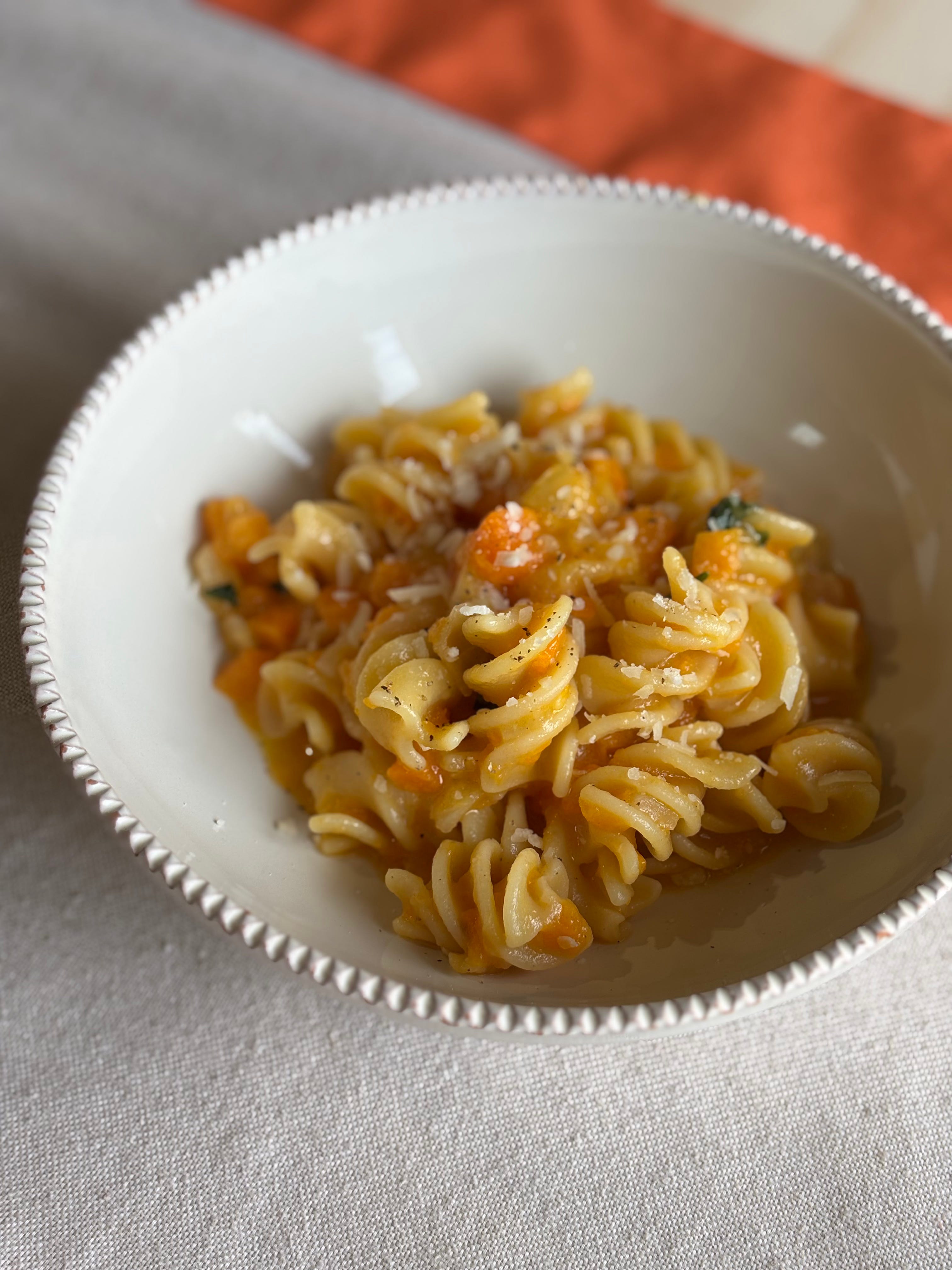
Fusilli with Sweet Potatoes and Provolone
Serves 6
Cooking time: 40 minutes
Ingredients
1.1 lb (500 g) fusilloni or fusilli pasta
4 medium sweet potatoes
3 garlic cloves
1 medium onion
5 oz (150 g) provolone or scamorza cheese, diced
3.5 oz (100 g) Parmigiano Reggiano, grated
1 rosemary sprig
10 fresh basil leaves
Extra virgin olive oil
Salt and black pepper
Warm water or vegetable broth, as needed
Directions
Peel the sweet potatoes and cut them into cubes. In a large pan, sauté the onion and finely chopped garlic with a generous drizzle of olive oil. Once softened and lightly golden, add the sweet potatoes and sauté for a few minutes.
When they begin to caramelize slightly, pour in two ladles of warm water or broth and cook until the potatoes start to fall apart. Add more liquid if necessary during cooking.
The final texture should be soft and creamy, but still rich and substantial. During the last 5 minutes of cooking, add a whole rosemary sprig to perfume the sauce, then remove it. Season with salt and black pepper.
Cook the pasta until al dente. Meanwhile, cut the provolone into cubes. Add the drained pasta and the provolone to the sweet potato cream and stir over low heat until the fusilli are completely coated and the cheese begins to melt into the sauce.
Finish with torn basil leaves and serve with a generous shower of Parmigiano Reggiano and freshly cracked black pepper.
Before leaving Grottaglie, I stopped to visit another friend of mine: the ceramic artist Giorgio di Palma.
The son of a ceramicist — his father is one too — Giorgio has reinvented the language of ceramics, creating a style that is entirely his own. His “ceramics nobody really needed” (the tagline of his brand) are everyday objects recreated in ceramic at a perfect 1:1 scale.


Ice creams and popsicles, photographic film rolls and cassette tapes, mozzarella balls and packets of chips, colored pencils and bouillon cubes: objects catapulted from the 1990s now crowd his atelier in the heart of Grottaglie. Useless and immortal at the same time.
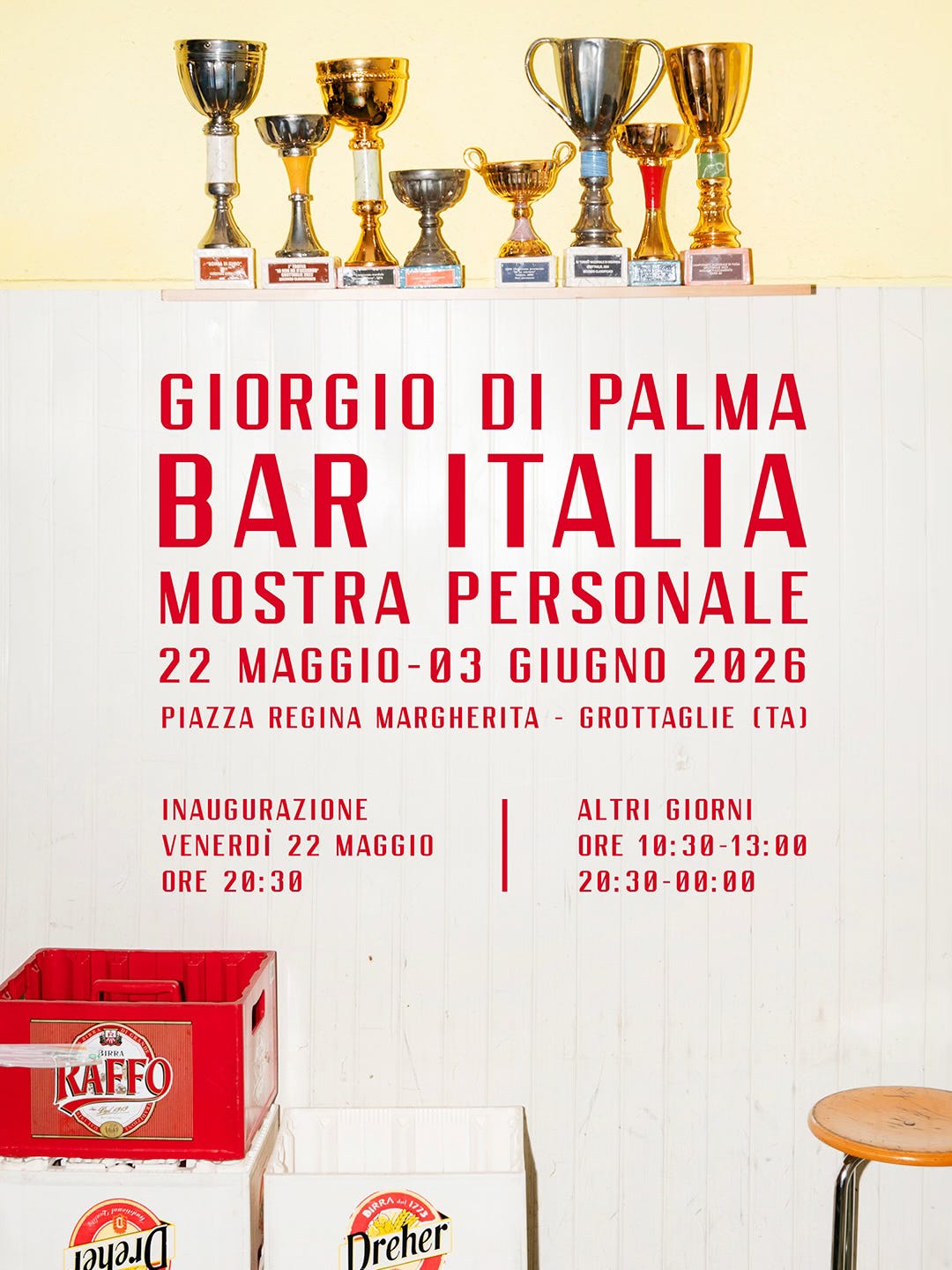
If you happen to be in the area, stop by to see his latest exhibition:
Bar Italia
May 22 – June 3, 2026
Piazza Regina Margherita, Grottaglie
And just as I am about to get into the car, I realize I parked right in front of Ceramiche Nicola Fasano.
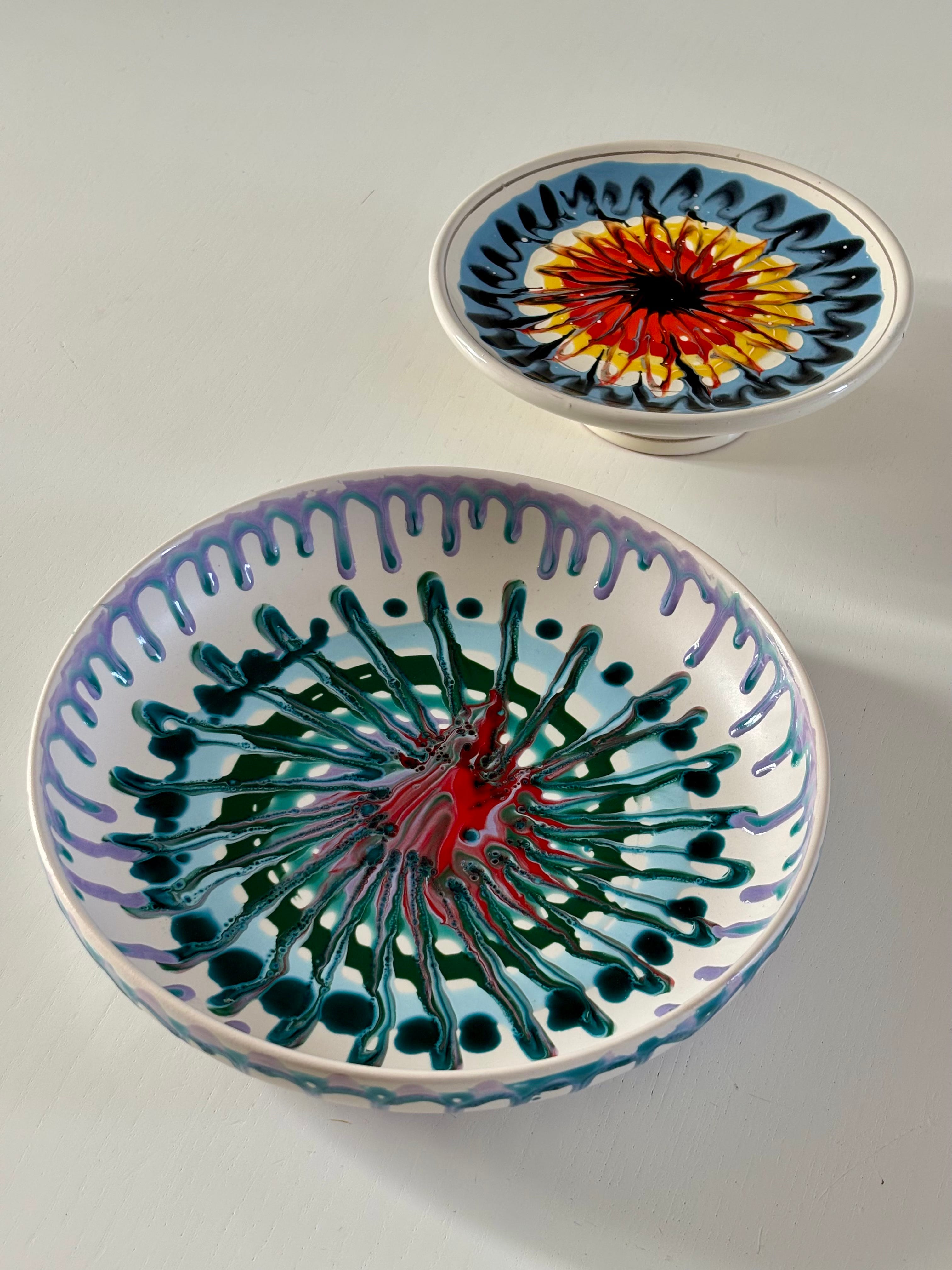
Ceramic makers for eighteen generations, the Fasano family is known for a style that is understated yet elegant, recognizable through its flowing drop-like patterns, where color drips softly across plates, trays, and cups like liquid paint.
I couldn’t resist adding two new pieces to my collection: a cake stand for serving cheese and a large salad bowl.
And so, I welcomed them into my kitchen too.
I still need to visit grottiglie 💜
yes thank you, I would love to meet you.