
Where the border disappears
A travel story among vineyards, walking paths, and slow cities between Italy and Slovenia

The first story of this year is not about Puglia.
Because there are places that slip quietly into your heart and simply wait to be told.
This year begins with a journey to Slovenia, where I was hosted by my friend Tamara Lukman, the beating heart - together with her partner Janko Štekar - of the winery Kmetija Štekar.
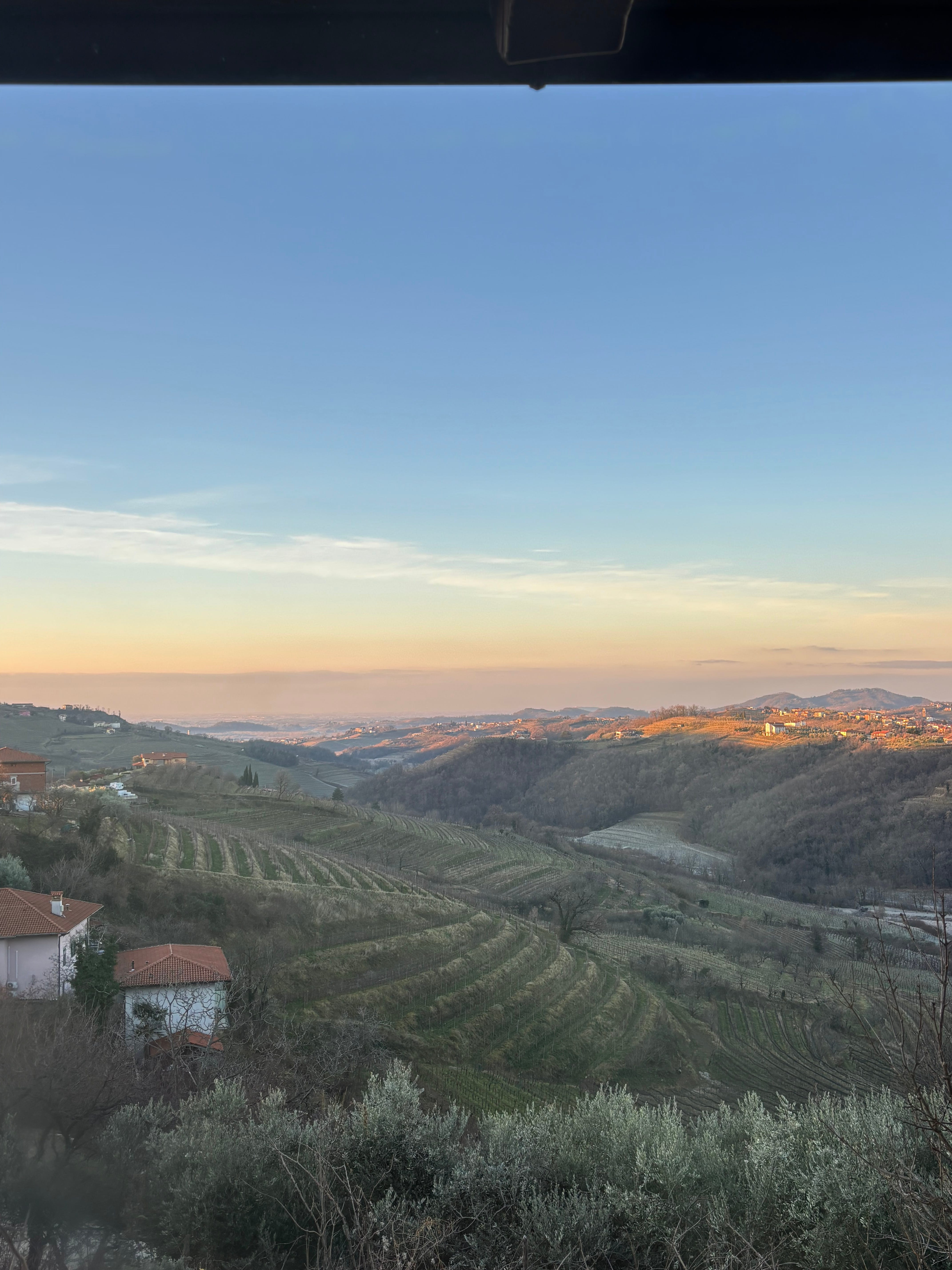
(Ph: the view from my room at Kmetija Štekar)
We are in Brda, in the Slovenian Collio, just a few kilometers from Italy: a borderland where place names, languages, and customs blend together.
“Here we’re all mixed,” Tamara tells me. “We’re in the heart of Europe. This is where the Balkans end and the Slavs meet the Latin world.”
Climbing Mount Sabotin - once a dramatic World War I battlefield - I look down at this strip of land from above. On one side lies the city of Gorizia, gently traced by the Isonzo River; on the other, its Slovenian alter ego, Nova Gorica. The vineyard-covered hills of the Collio, the Gulf of Trieste, and Istria unfold before me; behind, the Karst plateau rises with its primordial, wind-beaten rocks. Sea, sky, and land merge, softened by the winter haze that blurs the edges of things.


Through wars, humankind has tried to divide what nature conceived as a whole. In these territories, postwar borders were often arbitrary, even surreal. In 1947, in the Collio, there were houses with a front door in Italy and a back door in former Yugoslavia (now Slovenia); a stable in one country, a wine cellar in another.
This was also the case in Gorizia, which - like Berlin - was once cut in two by a wall: Italy on one side, Yugoslavia on the other. And yet, stubbornly, it remained a place of passage and exchange, beyond every line drawn on a map.


Visiting these lands in winter means being lucky enough to cross paths with the season of the “Rose from Gorizia”, a type of radicchio with an intense violet-fuchsia color, produced using an ancient method. The chicory is first grown outdoors; then the bunches - dark purple, almost black - are moved into enclosed spaces such as cellars and stables, where they are watered regularly. Over about twenty days, the outer leaves rot and are removed, revealing the heart of the plant: a rose with a sweet flavor and a tender texture.


In the Collio, time has always been a value. Knowing how to wait is a resource. In wine, too. The maceration of white grapes - Ribolla in particular - has its roots in very practical, deeply rural needs. Vineyards belonged to small families, and harvesting took place over several days. Filling a wine press took time: grapes were added little by little, and the first batches would already begin fermenting, naturally extending the contact between skins and must. This maceration made white wines more stable and long-lived, adding structure, complexity, and a deeper color.
In the 1990s this ancient practice was reinterpreted and transformed, thanks to the vision of Joško Gravner and Stanko Radikon, key figures in the contemporary Collio. Inspired by studies of ancient Mesopotamia and by Georgia’s terracotta amphora winemaking tradition, Gravner applied these methods to local grapes - Ribolla Gialla first and foremost - creating a new expressive language. Thus were born amber-hued white wines, long macerated on their skins, unfiltered, intense: scented with spices and ripe fruit, with a present, almost chewable tannin.
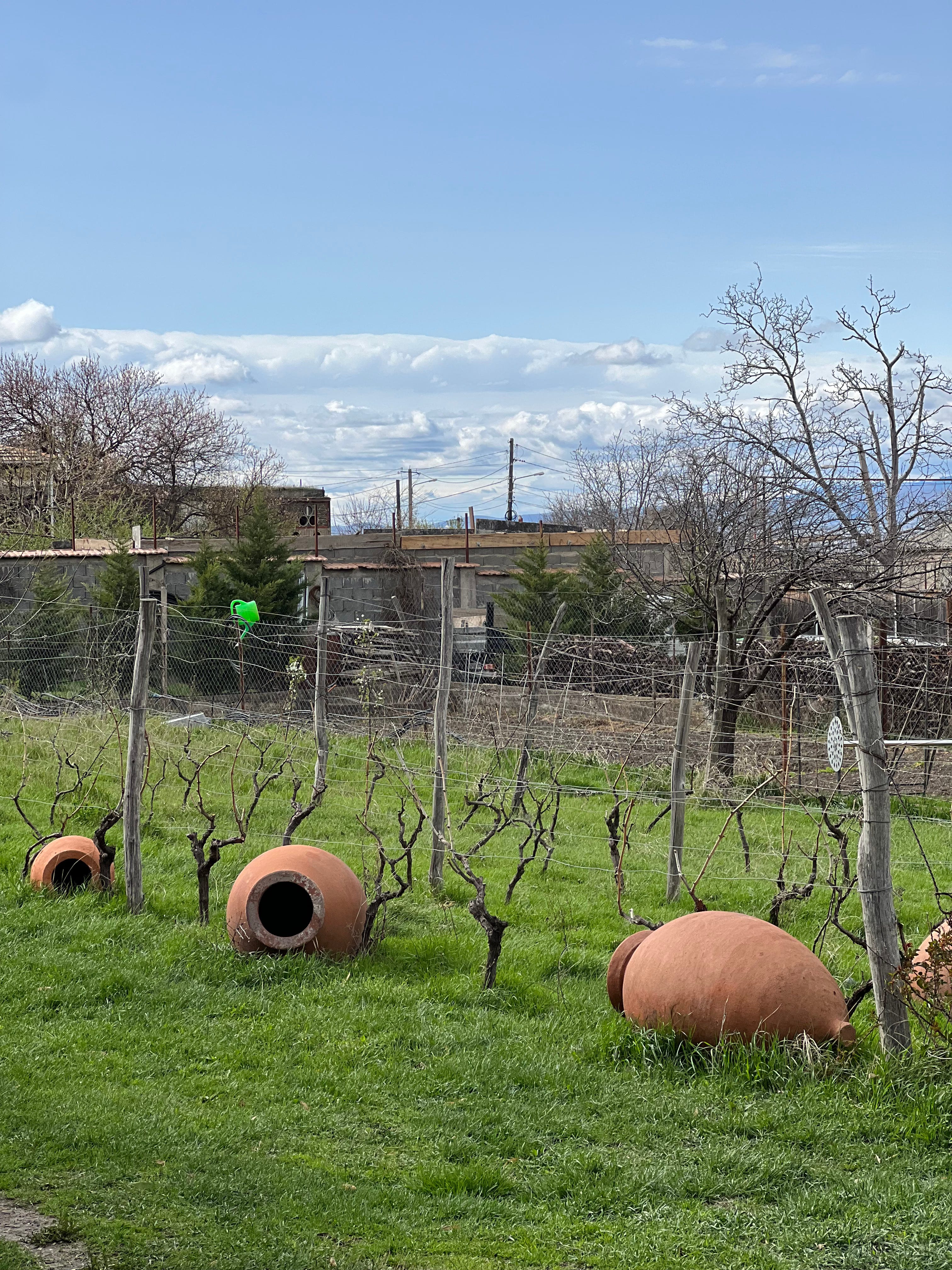
(Ph: Georgian amphorae - kvevri- in Mtskheta, Georgia)
It was 2013 when Stefania, from Vineria Est in Bari, handed me a glass of my very first “orange” wine. It was a Ribolla from Radikon, and it felt like an initiation. Finding myself just a few kilometers from that winery made the visit inevitable.
The story of Radikon is a story of resistance. We are at the foot of Mount Sabotin, a mountain scarred by war, flattened and blasted by artillery. In this wounded land, wine becomes a slow, obstinate way of healing.
Descending into the cellar with Ivana Radikon (daughter of Stanko Radikon), I quite literally enter the entrails of the Collio. Walls of “ponca” - the damp flysch typical of these marlstone and sandstone hills - surround large truncated-cone vats, where white grapes rest on their skins for three months. There are no shortcuts here: hand harvesting, native yeasts, no chemical or physical treatments. This is how the winery’s emblematic wines are born: Ribolla Gialla, Oslavje, and Jakot.
Jakot is also a declaration of freedom. It is the name chosen and registered by the Radikon family for what was once called Tocai - a name that could no longer be used, neither as Tocaj, reserved for Hungary, nor as Friulano, because it fell outside the borders imposed by the Friulano DOC regulations.


Jakot, which at Kmetija Štekar becomes… Jankot: Janko’s Tocaj. Walking through the vineyard, looking closely between the rows, these vines immediately remind me of my winemaker friend’s character: exuberant, vigorous, a little wild.
Janko and Tamara’s approach to viticulture is deeply rural, stripped of frills, with very few interventions in the vineyard. Their wines are an expression of nature itself - a juice of the land - born from work on soil that has belonged to the Štekar family for ten generations.


To me, their family and their farm embody Slovenian identity and a special relationship with natural cycles, with the care of the garden and the plants. A microcosm where each season brings its own preservation, its own task: cherry juice in summer, dried persimmons and new olive oil in autumn, pig slaughtering in winter and the making of cured meats. A farming world in which wine production is a luminous piece, a time of nature, a ritual to be respected. This is the philosophy I absorb while spending time with them at their rural b&b, overlooking the hills of Brda, among vineyards, olive trees, and slow sunsets.


An ancestral way of doing things, paired with a desire to experiment purely for the joy of it - such as their work with Pinot Gris, one of Štekar’s iconic wines, and their very personal interpretation of Rhine Riesling.


Here in Slovenia, winemakers know how to work as a network. They exchange practices, support one another, build community. Many are small, family-run estates, and their way of making wine is their way of interpreting the world.
If Slovenian macerated wines - orange, amber - form a category of their own, each producer approaches them differently, according to personality.
And it is precisely about personality, heritage, and family stories that I find myself talking over a table with Simon Woolf, founder of The Morning Claret, one of the most respected voices in the world of natural, artisanal, organic, and biodynamic wine. He is also the author of Amber Revolution, a journey through Friuli, Slovenia, the Caucasus, and Georgia, where he explores the world of amber wines through history, technology, and geography - seasoned with very British wit and sharpness.
The book also includes his personal selection of 180 producers from around the world: 180 stories of wine, people, and ways of seeing the world.
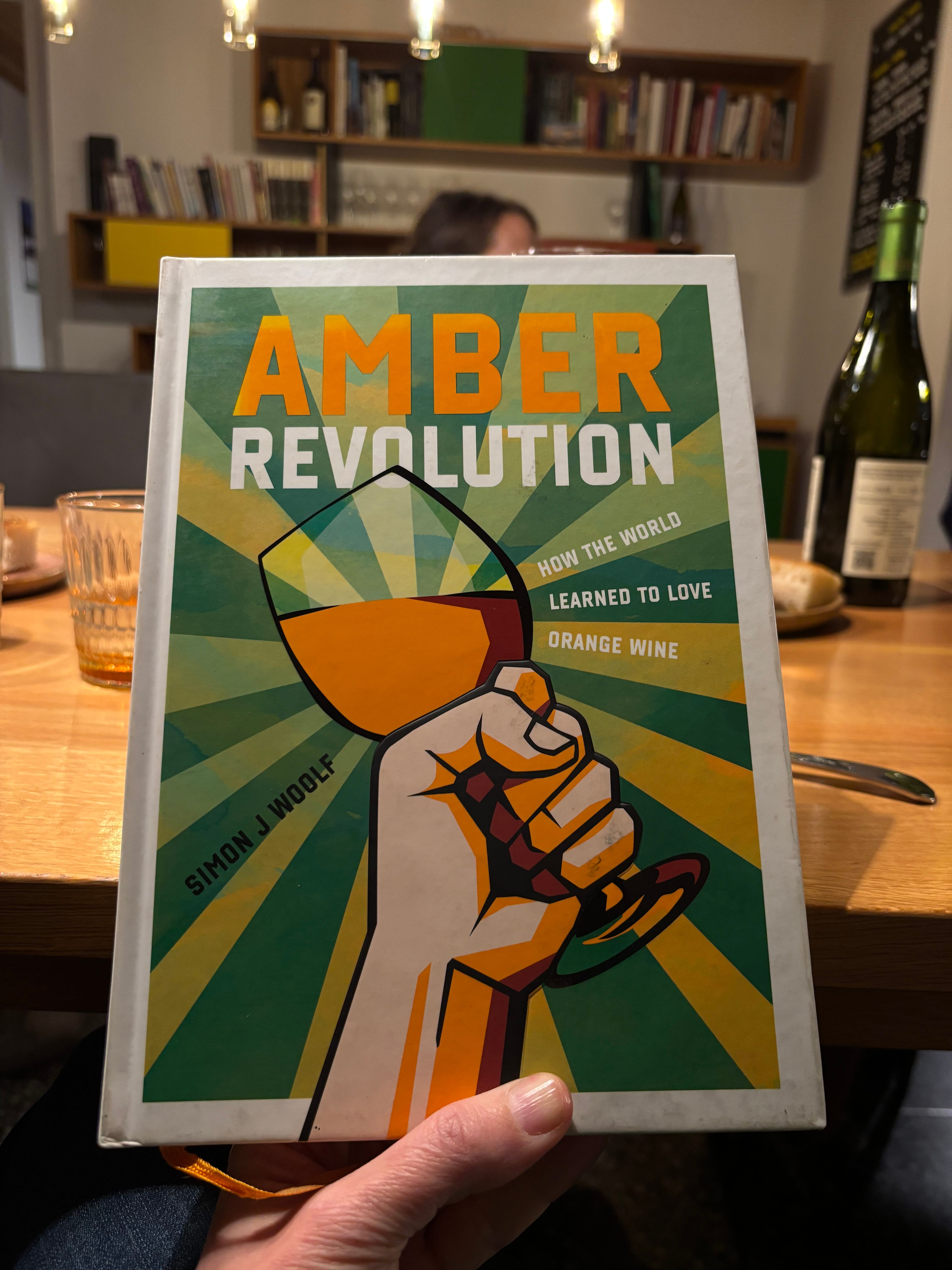
(Ph: Amber Revolution at Burja’s Estate)
The setting for this conversation is the tasting room of Burja winery, hosted by Primož Lavrenčič and his wife Mateja Zidarich.
We are in the Vipava Valley, a few kilometers southeast of Collio. Burja - the winery’s name - is the Slovenian word for the “bora”, the northeast wind that blows relentlessly here. Trees grow low, crops are protected by stone walls that break the wind, whose gusts can reach up to 240 km/h.
The Burja manifesto rests on two pillars: the valorization of indigenous grape varieties and a modern interpretation of enology. These ideas take shape in one of the winery’s emblematic wines, Stranice: Istrian Malvasia, macerated for 24 months in concrete eggs.
Primož is a pioneer of this type of vessel in Slovenia. Like barriques, concrete eggs allow for perfect micro-oxygenation, helping the wine mature and soften its tannins. Unlike wood, however, concrete does not release tertiary aromas of toast, spice, or vanilla that might cover Malvasia’s floral and citrus notes.
Walking through the cellar, among eggs and barrels, surrounded by wine fair posters and illustrations that turn the space into a small underground art gallery, I taste two local whites: Laški Rizling (Italian Riesling) and Zelen - a grape whose name recalls both the green color of its skin and the pea-sized shape of its clusters - saline and vibrant.


I can’t leave Slovenia without a stop - however brief - in its capital: Ljubljana. I love wandering through the historic center, dotted with pastel-colored buildings that rise softly against a sky heavy with snow-laden clouds.
With Tamara, we walk along the river past Center Rog, once the factory of the iconic Rog bicycles until the 1990s, now a cultural hub dedicated to design and creativity: ceramic and 3D jewelry workshops, photography galleries, restaurants, and reading spaces.


The old sugar factory from the mid-1800s now houses the Cukrarna Gallery, one of the city’s contemporary art spaces. Inside its white-cube interiors, we attend a retrospective dedicated to Marina Abramović and Ulay.


One last glass of wine at Kletvica natural wine bar, a cheese burek from Nobel Burek (a local institution), and I leave Ljubljana with the desire to return.
I set off again carrying the wind on my skin, the saline taste of the wines, the violet color of the soil, and the certainty that some landscapes are not meant to be visited: they are meant to be crossed - slowly - and then they stay with you.
Post scriptum, in loving memory of Simona Klinec ❤️
For me, places are made of the people who inhabit them. And Slovenia has always worn the face and laughter of Tamara - whom you’ve met in this story - and of Simona, one of the undisputed queens of Slovenian wine.
I met them both in Barcelona, during the Parabere Forum, a conference dedicated to women’s empowerment in food and wine, which I’ve attended for nearly ten years. On that occasion, we shared for three days a crowded apartment in the heart of the city - eight rooms and eight bathrooms - rented by my friend Fia Gullikson who brought together, like a beautiful bouquet, some of the women and colleagues with whom I’ve shared the most over the past years.
For a few months now, Simona has been gone. She is missing from this story, she is missing from my life, from Tamara’s, from Slovenia.
Writing is a way of remembering. Telling stories is a way of bringing people back to life. And so this journey is also for you, Simona.
Na zdravje, amica.
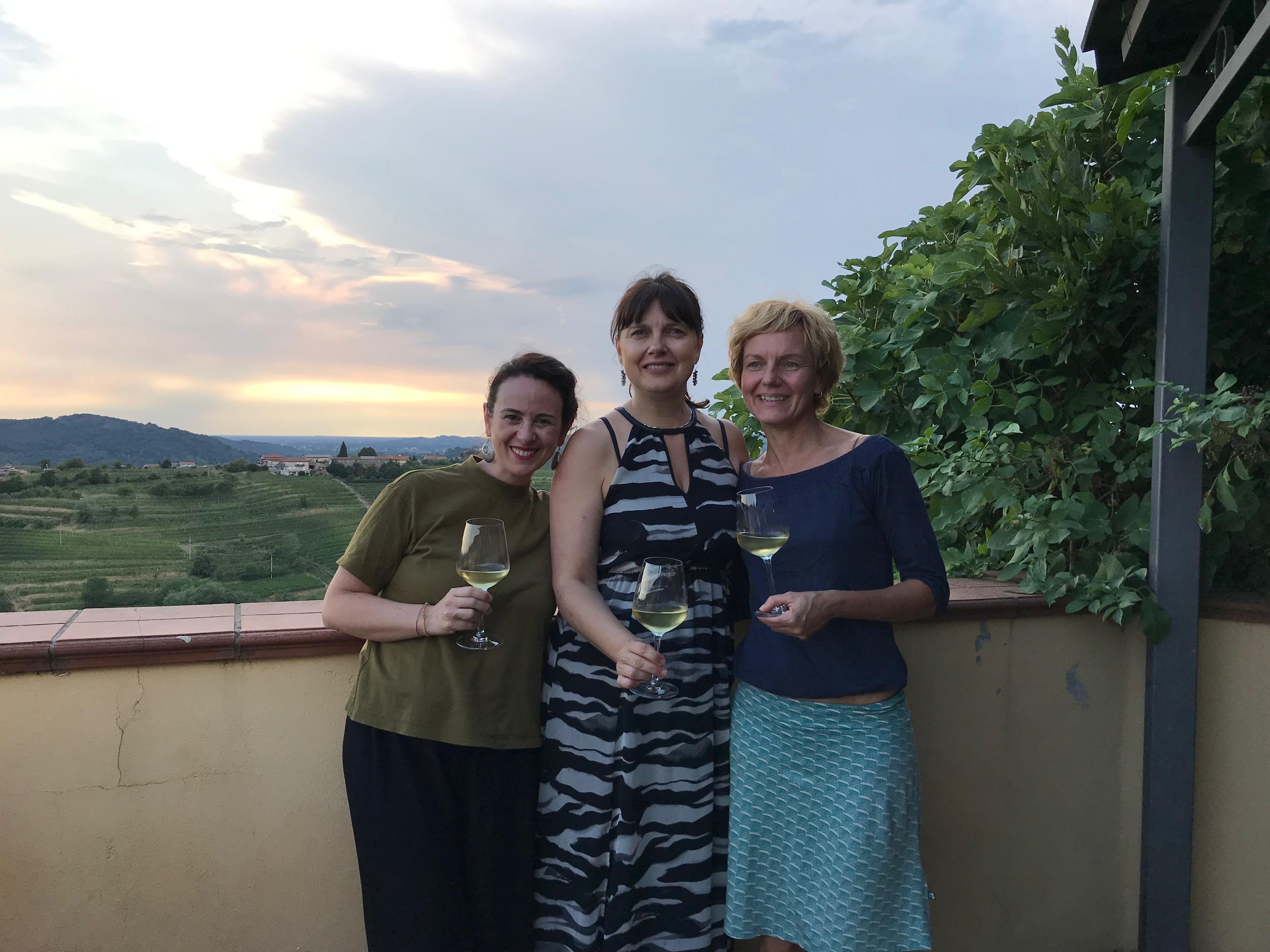
Thank you Flavia!! Again and again! So much new information! Wonderful world and wonderful story! Have to see and taste! Have experience and joy!!! 😘❤️